


First, what a credit score actually is
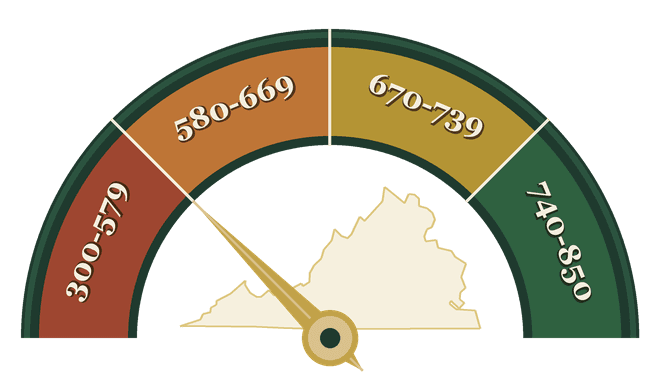
Your credit score is a three-digit number (most commonly a FICO score, on a scale from 300 to 850) that lenders use to estimate how likely you are to repay a loan. Higher is better. Roughly speaking, scores in the 740s and up are considered excellent, the 670–739 range is good, 580–669 is fair, and below 580 is where loans get harder to come by. The number is built mostly from your payment history and how much of your available credit you're using, with a few other factors mixed in.
Here's the part most first-time buyers don't realize: you do not need a high score to buy a home. You need a score that qualifies you for a loan program, plus the income and savings to back it up. Plenty of people buy with fair credit.
Typical score ranges by loan type
These are general industry guidelines, not hard rules — every lender sets its own overlays, and the figures move. Treat them as a starting point for a conversation with a lender, not a cutoff written in stone.
- Conventional loan — around 620+. The most common loan type. 620 is a frequent floor, though a higher score gets you a noticeably better rate and lower mortgage-insurance cost.
- FHA loan — 580 with 3.5% down. FHA is designed for lower-credit and first-time buyers. At 580+ you can put as little as 3.5% down; between 500 and 579 it's often still possible with 10% down, depending on the lender.
- VA loan — no official minimum (lenders often want ~580–620). The VA itself sets no credit-score minimum, but individual lenders do. For eligible veterans and service members this is one of the strongest loans available — often $0 down.
- USDA loan — no official minimum (often ~640 for the easy path). USDA rural-development loans set no firm minimum, but a score around 640 typically unlocks the lender's automated approval, which makes the process smoother. Also $0 down in eligible rural areas.
Two of those last loans are the rare $0-down options still around — we walk through who qualifies and how they work in the VA and USDA loan guide.
Your score sets your rate — it's not pass/fail
This is the mindset shift that matters. Lenders don't just check whether you clear a number; they price your loan based on it. A buyer with a 760 and a buyer with a 640 can both get the same loan — but the 760 will usually get a lower interest rate, which can mean a meaningful difference in the monthly payment over the life of the loan.
So the goal isn't "hit some perfect score." It's to get your score into the best band you reasonably can before you lock a rate, because that's where it pays you back. Sometimes waiting a few months to nudge a score up a tier is worth it; sometimes buying now is the right call. A lender can show you both scenarios side by side.
What to do if your score isn't where you want it
If your number is lower than you'd like, you have more control than you think — and none of this is exotic. In general terms:
- Pay every bill on time. Payment history is the single biggest factor. One stretch of on-time payments moves the needle more than almost anything.
- Bring down your balances. Using a smaller share of your available credit (your "utilization") tends to lift your score, often fairly quickly.
- Don't open or close a bunch of accounts right before buying. New applications and sudden changes can ding your score at exactly the wrong moment.
- Check your report for errors. You're entitled to free credit reports, and mistakes are common. Disputing a genuine error can raise a score that was being held down unfairly.
For anything beyond the basics, a licensed lender or a reputable non-profit credit counselor is the right person to talk to — and it's free to ask. We're glad to point you toward local lenders who do this honestly.
It's never just the score
A credit score is one ingredient. When a lender decides what you qualify for, they also look at your income, your debt-to-income ratio (how much of your monthly income already goes to debts), your savings and down payment, and your job history. A strong score with high debt can be weaker than a fair score with low debt and steady income. That's why the real answer to "can I buy?" comes from a pre-approval, where a lender looks at the whole picture — not from a score alone.
How much you actually need saved is its own question, and the answer is usually less than people fear. We break it down in the down-payment guide and walk the whole journey in the first-time buyer guide.
Written by

Jesse Stidham & Emilia Domnaru
Founder & Co-founder, Casa Domnaru — Southwest Virginia
Last updated May 30, 2026